An illustrated journal. A clearer way into the work.
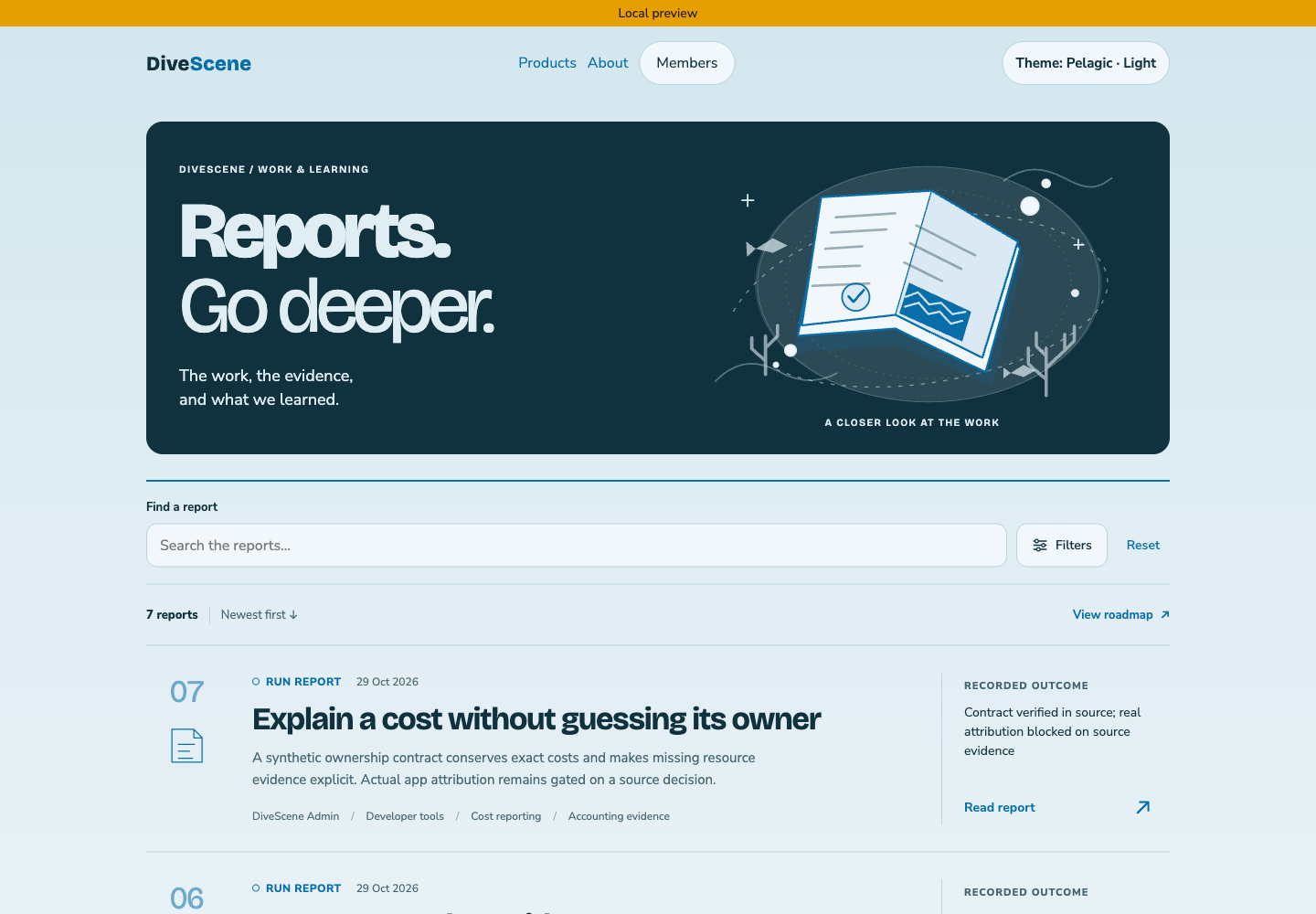
The reports library now has a bespoke underwater logbook, a stronger ink-and-paper cover and a readable journal layout. Compact filters make room for the reports; opening a full report now preserves a direct route back to the same selection.
Parked: usable, but still too generic.
Dean’s assessment: the landing page is definitely better, but still feels like a boilerplate tech-agency “who we are” page. The usability and technical checks passed; the requested distinctive visual character has not yet earned human acceptance. This is a useful source checkpoint, not a finished design success.
Lifecycle: Parked. Disposition: awaiting comparison; no design selected. Availability: open, unmerged source PR #448; no deployment. Value: verified usability evidence, mixed design feedback, reader benefit unmeasured.
Revisit condition: Dean brings Claude’s design alternatives for comparison with this implementation. Compare the list and individual-report experience, then decide whether to resume, combine directions or retire this design. No automatic resumption or background design work is scheduled.
Learning: automated usability checks and independent code review do not establish visual originality or human preference. Earlier builder scores below are historical self-assessments, not an overall success rating; aesthetic acceptance remains unmet.
The prior closing report follows as a dated source checkpoint. Its “source run closed” wording describes the completed execution attempt, not the current mission status. Original snapshots, scores, review evidence and screenshots are preserved.
Reviewed source, ready for a visual decision.
The actual repository reviewer completed at 10:08:58 UTC on ffaf84e with no findings. That review covers the final report-specific runtime and original visual export. The separately reviewed shared shell from PR449 was then incorporated; report-specific code remains byte-identical. Combined required checks passed: 420 repository, 23 SSO and 46 infrastructure tests.
Source PR #448 · Actual review receipt · Current closing facts
Current independent verification: 2/3 against the actual separate review. Other builder scores remain usefulness 2, correctness evidence 2, efficiency 1, observability 1 and learning 2. The earlier report below preserves its review-pending snapshot and score; original evidence files have not been rewritten.
Lifecycle: source run closed. Disposition: implemented. Availability: pushed source PR, not deployed. Benefit: unmeasured in human use. The final closing sample is 42.56 minutes from the original clock, inside the author-selected 60-minute checkpoint, including combined verification and confirmed QA cleanup. Final metadata push and handoff follow separately. Shared weekly usage reached35% at the later sample; concurrent work prevents attributing that delta to this mission. Per-actor tokens, monetary/reviewer cost and secondary quota remain unavailable.
What changed for the reader
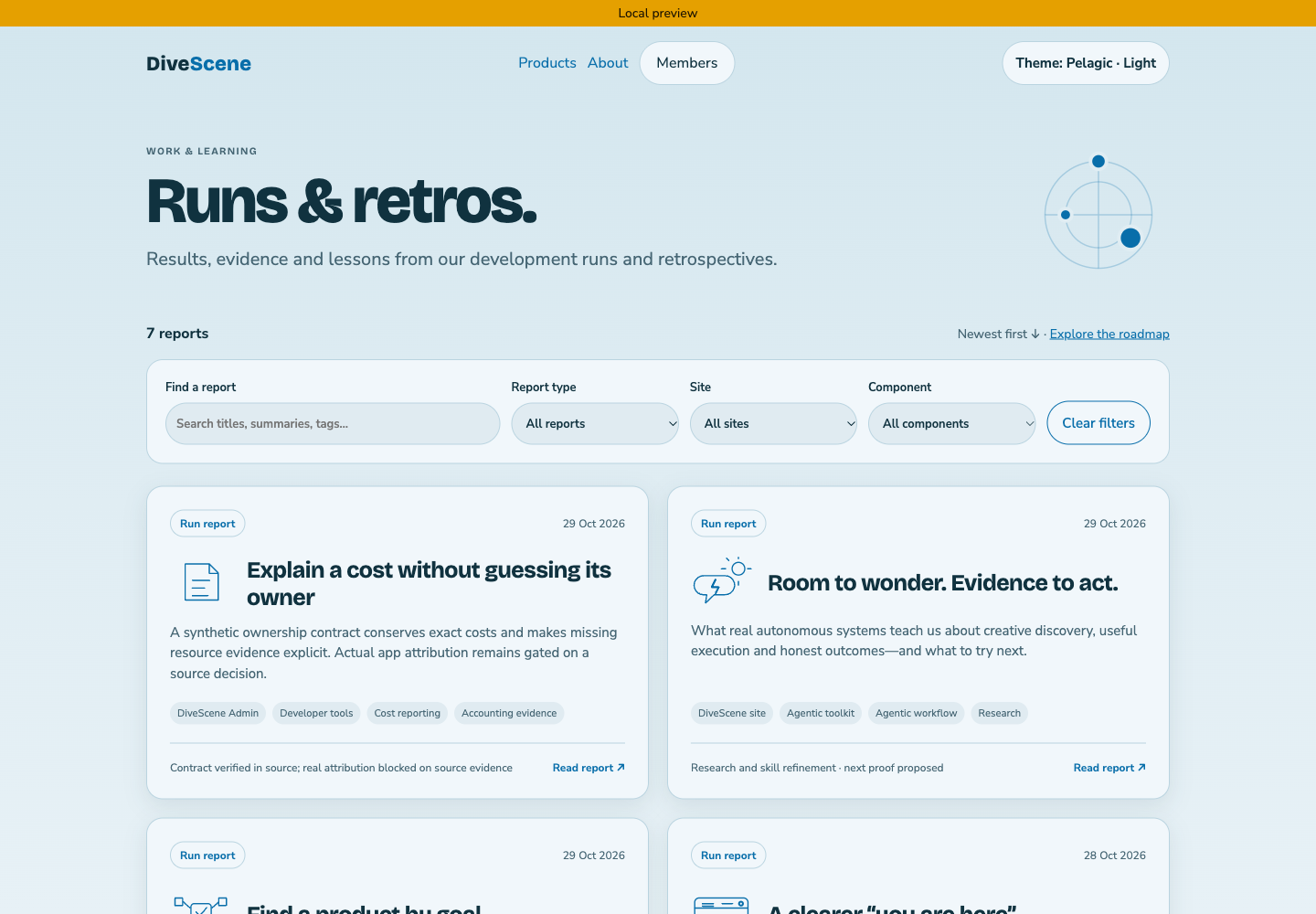
Dean wanted the page to feel distinctive and engaging, while staying easy to use. His clarification was specific: the existing page felt too safe and lacked fun imagery, animation and visual effects. Codex chose the illustrated journal direction and drew the vector scene in source, using the existing brand colours and fonts.
The type badge says what kind of report it is. A separate “Recorded outcome” area carries the original outcome. Neither decoration nor numbering invents a mission category, work status, deployment or measured benefit.
Did it add value? The source demonstrates a more expressive design and a shorter path to the first report, with the complete browsing journey retained. Whether people prefer it, find it easier or use the reports more is still unmeasured. This is agent inspection of local source, not human usability evidence or a deployed result.
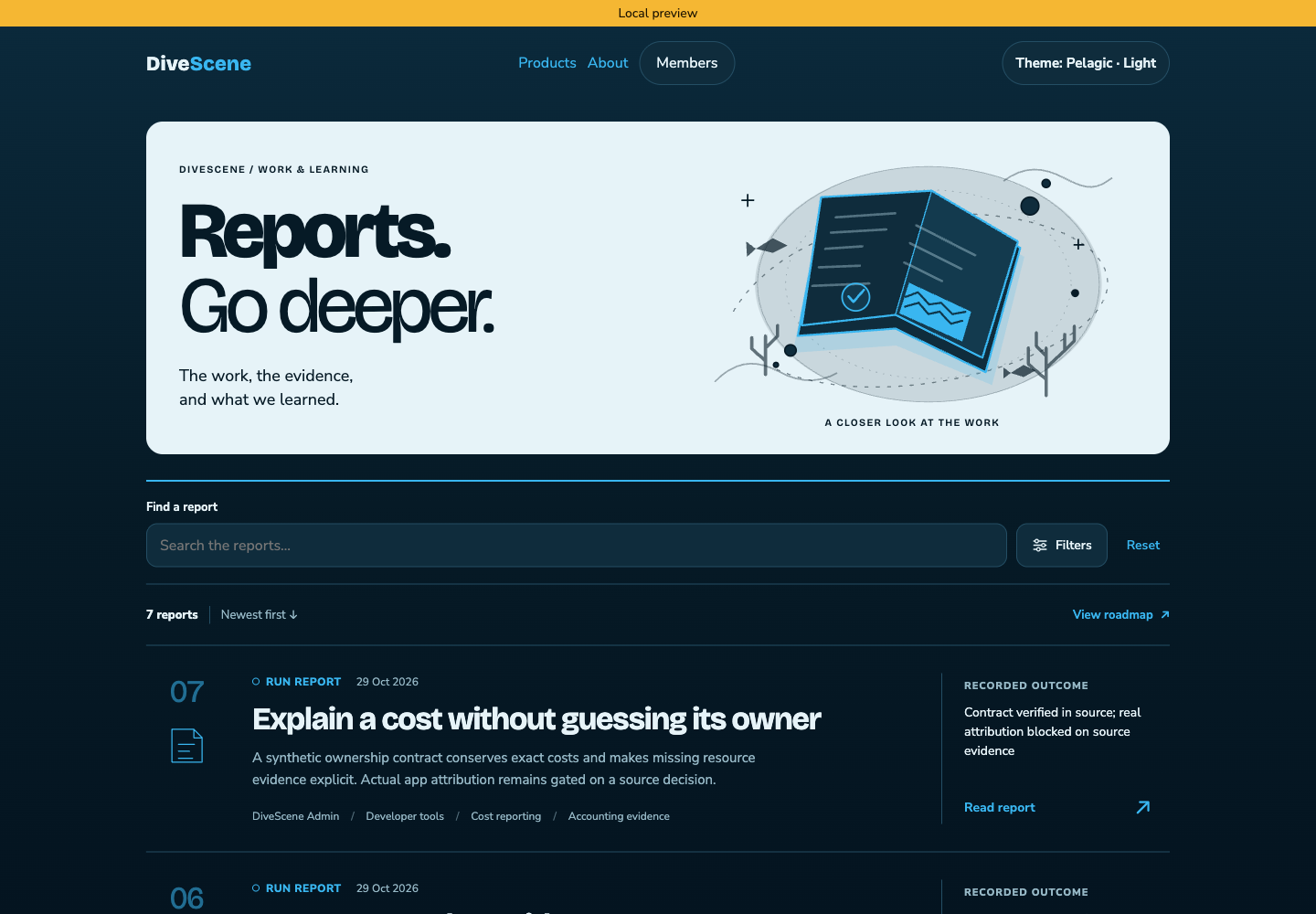
Before → after, on the same content
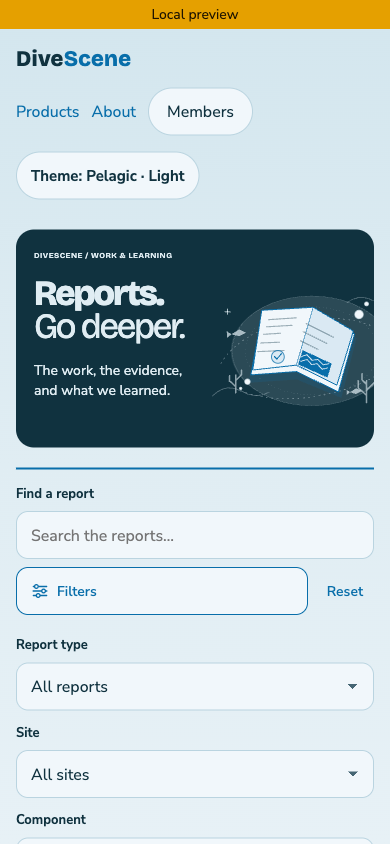
Actual local screenshots at 1440 × 1000. Before: integrated source 078ef79 with seven reports. After: the same seven-report collection, before this closing report was registered. The parent’s earlier research/content additions are not claimed as part of this redesign.
Phone first, including the controls
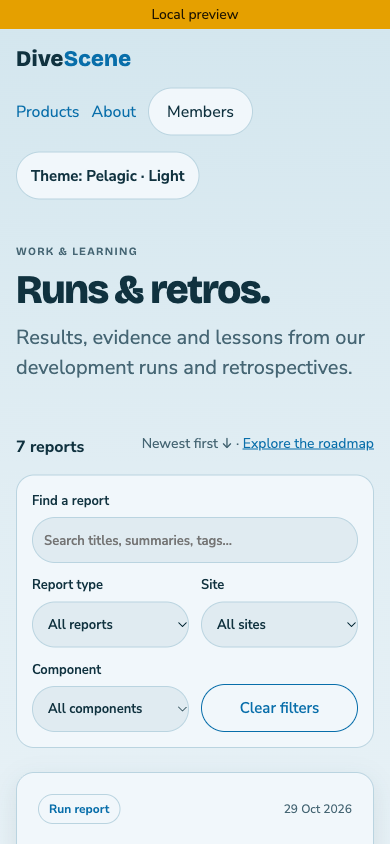
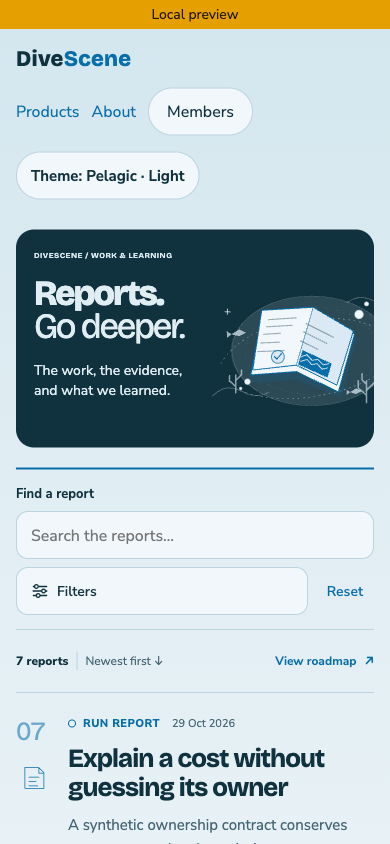
Search stays visible. The Filters button shows how many secondary filters are active; opening a shared filtered link reveals the selected controls. Select arrows are inset with text clearance, long options stay inside the field, and Reset restores both the list and search focus.
The full report’s return link carries the selected search, type, site and component in the URL. Browser Back also retains the selection. With JavaScript disabled, every report and the ordinary All reports return link remain available.
Origin, authorship and evolution
Initiator: Dean, human owner; trigger: direct_request. Requested outcome: Dean. Design selection, illustration, implementation and report: fresh Codex coordinator/builder. Parent Codex: interface, source serialization and eventual integration. The automatic repository reviewer is a separate reserved actor; its actual result is recorded at closing. This mission was not autonomously discovered.
The initial direction was a typography-led journal after observing how much phone space the filters consumed. Dean’s imagery/motion clarification expanded that into an underwater logbook cover. Rendered inspection caught a narrow-screen illustration overflow; the builder fixed it and strengthened the contrast of the cover. An image-heavy magazine would add unrelated asset work; a dashboard would imply live status or analytics that do not exist. Neither was selected.
What was actually checked
Thirty-four browser assertions passed across discovery, combined filters/search, shared URLs/reload, full report opening, explicit filtered return, browser Back, empty/reset, keyboard disclosure, invalid input and no-JavaScript access. Supplementary inspection covered all ten brand themes at 320 px, widths of 320/390/768/1440 px, long selected labels, original visual-report images after lazy loading and the reduced-motion state. No uncaught browser errors were observed.
The required npm run check passed: 420 repository tests, 23 SSO tests and 46 infrastructure tests. The first restricted run failed because local test listeners were denied; the authorized listener-capable run passed. These infrastructure tests are existing repository requirements, not new cloud operations.
Budget, evidence and limits
The author selected a 60-minute checkpoint, 09:34:35–10:34:35 UTC, covering design, the source-base wait, an interruption, build, verification, review, this report and cleanup. Shared weekly quota was 31% at the first builder reading, 32% after resuming and 33% before the later verification phase. Those readings include concurrent account work; they are not an attributable mission cost.
Per-actor token counters and monetary cost are unavailable through the current worker tools. Parent research/skill work is a separate package. Reviewer usage is unknown. The secondary quota window was unavailable; this does not prove it does not exist. Cached/reasoning counters, if available later, are subsets rather than extra totals.
Rework retained: Chrome file captures were rejected before native Playwright capture succeeded; local listener permissions required an authorized retry; a rendered overflow was fixed; a scroll-relative metric was corrected to scroll position zero. One check phase initially used a stale quota sample, immediately followed by a fresh 33% reading. That process deviation is recorded rather than described as full admission compliance.
| Dimension | Score / 3 | Builder’s evidence |
|---|---|---|
| Usefulness | 2 | Verified source change and a shorter phone entry; human benefit unmeasured. |
| Correctness evidence | 2 | Positive/negative whole-journey and required checks passed. |
| Efficiency | 1 | Bounded work with documented avoidable attempts. |
| Observability | 1 | Origin/time/quota retained; per-actor costs incomplete. |
| Independent verification | 1 | Pending at this snapshot; closing evidence will preserve the actual verdict. |
| Learning | 2 | Concrete overflow, return-path and motion corrections applied. |
Rubric: bounded-agentic-development v0.2, separate anchored dimensions. Author self-assessment; no composite score and no score3 benefit claim.
Now, next and deliberately deferred
Lifecycle: source checkpointDisposition: implementedAvailability: isolated local preview / source PRBenefit: unmeasured
Implemented now: illustrated journal, finite motion, compact responsive filters, clearer report/outcome hierarchy and filtered full-report return. Existing report content, URLs and chronological ordering stay intact. No new dependencies, analytics, scheduler, live registry or cloud resources were added.
Next gate: actual independent review, then the parent’s source integration decision. Deployment keeps its existing authority. Deferred: human preference/usability observation, any decision to publish, and measured engagement. Revisit after Dean has inspected the design or actual readers have used it. The illustration is code-native, not an image-generation dependency.
The useful lesson is practical: expressive artwork and motion can coexist with a shorter browsing path, but the rendered phone must decide whether the composition works. This source run establishes that bounded interface result; it does not establish audience preference or total cost efficiency.
Combined with the separately reviewed site controls
The final branch incorporates shared-shell PR #449. A bounded check at 320, 390, 640, 768 and 1440 px confirmed 48 px report controls, 16 px input/select text, 42 px right clearance for select text and no horizontal overflow. The combined filtered-report return still works. The closing report also fits 390 px.
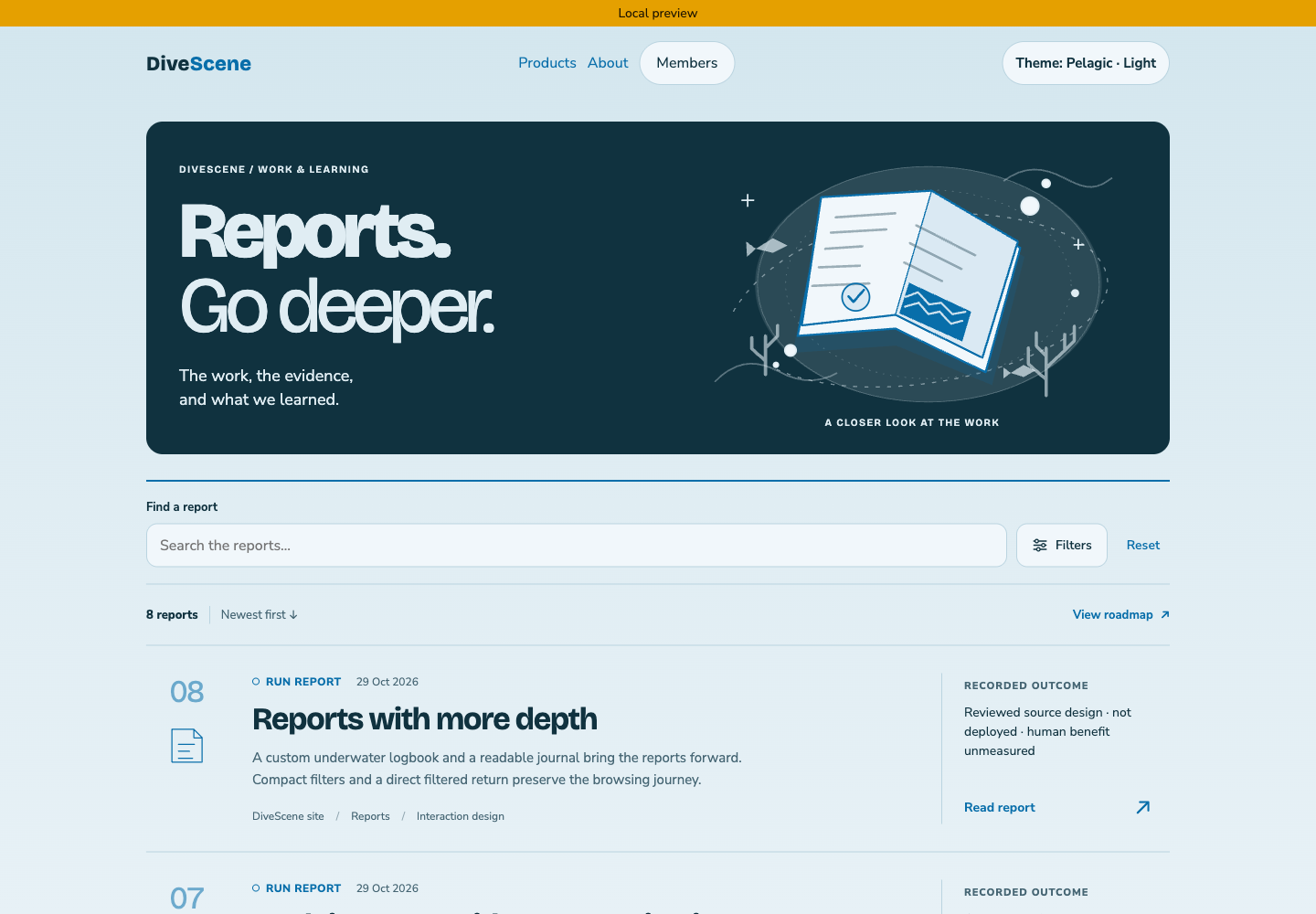
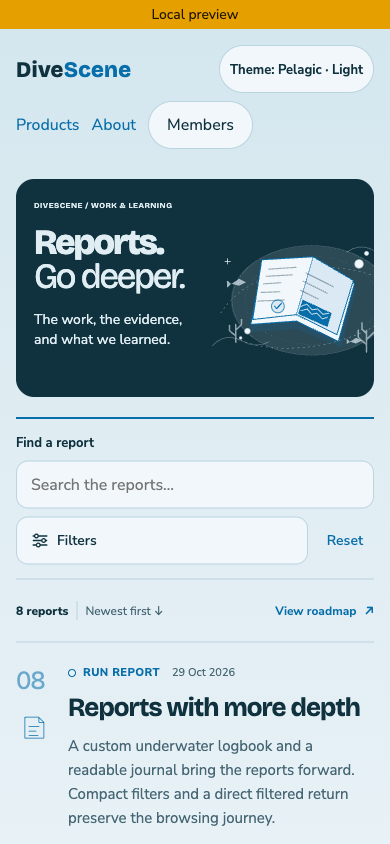
The original matched seven-entry before/after comparison above stays intact to isolate the redesign. The combined first entry begins at 641.5 px; the shorter shared header contributes to that later position.
Curated evidence
Origin and evolution · Original intent · Verification scope · Anchored score snapshot · Measurements and gaps · Curated phase audit · Export manifest
Only this selected report and its declared images are emitted by the reports build. Evidence files remain source-linked. Raw provider transcripts, hidden reasoning, credentials and unrelated/private media are excluded.