DiveScene · Agentic product pilot 004 · 29 October 2026
Find a product by what you want to do.
A visitor can choose a goal, see the matching product and share that selection with a link.
Judgment: worth trying as a small discovery prototype. It adds a complete path from a visitor’s intent to a product. Real demand and improvement in discovery have not been measured.
Publication snapshot: 2026-10-29 07:31:23 UTC. Automatic review and final publication are later gates; this report makes no independent-review pass claim. The final handoff carries the actual PR, exact head, review and cleanup evidence.
What changed
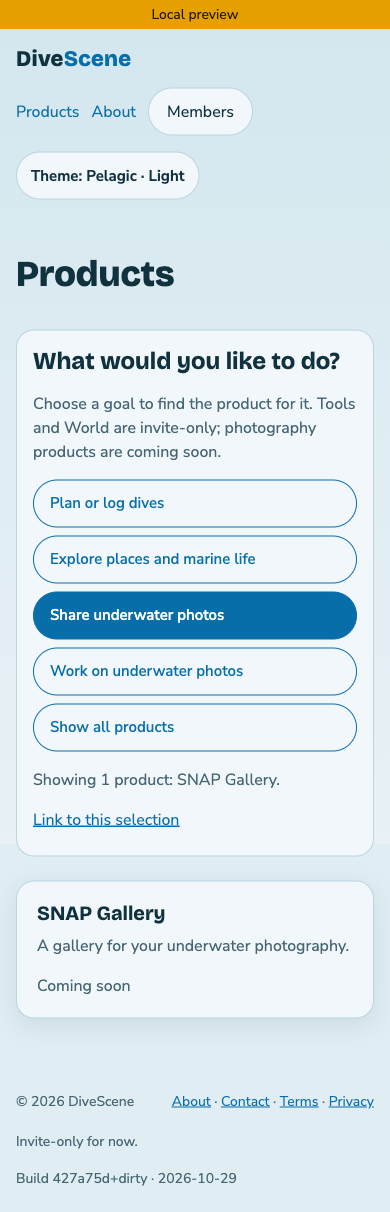
Before, visitors read four product cards and worked out which one matched their goal. Now they can choose a goal first. The labeled native menu keeps choices compact on a phone. The matching card retains its existing destination or “Coming soon” status. “Show all products” restores the full catalogue.
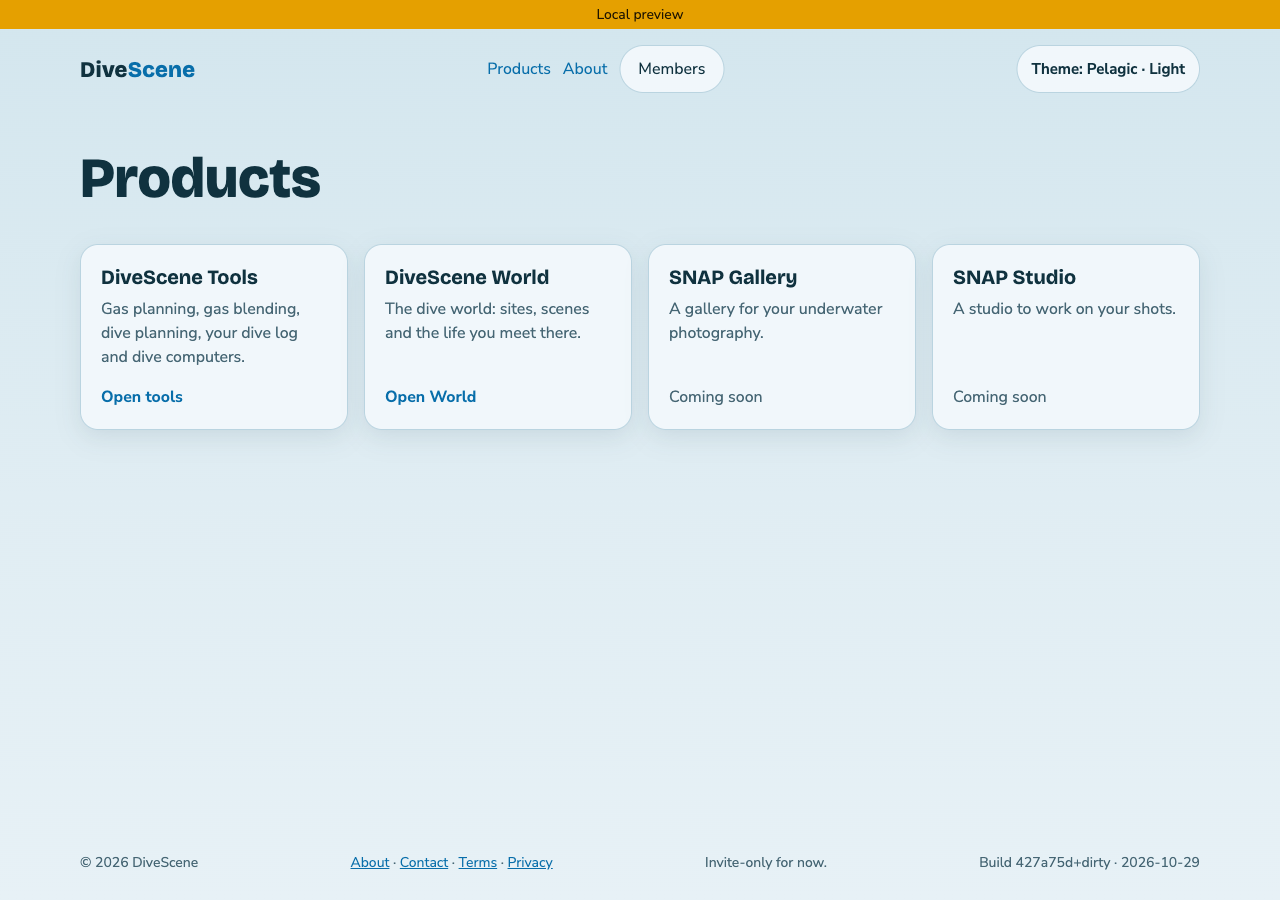
427a75d, 1280 × 900.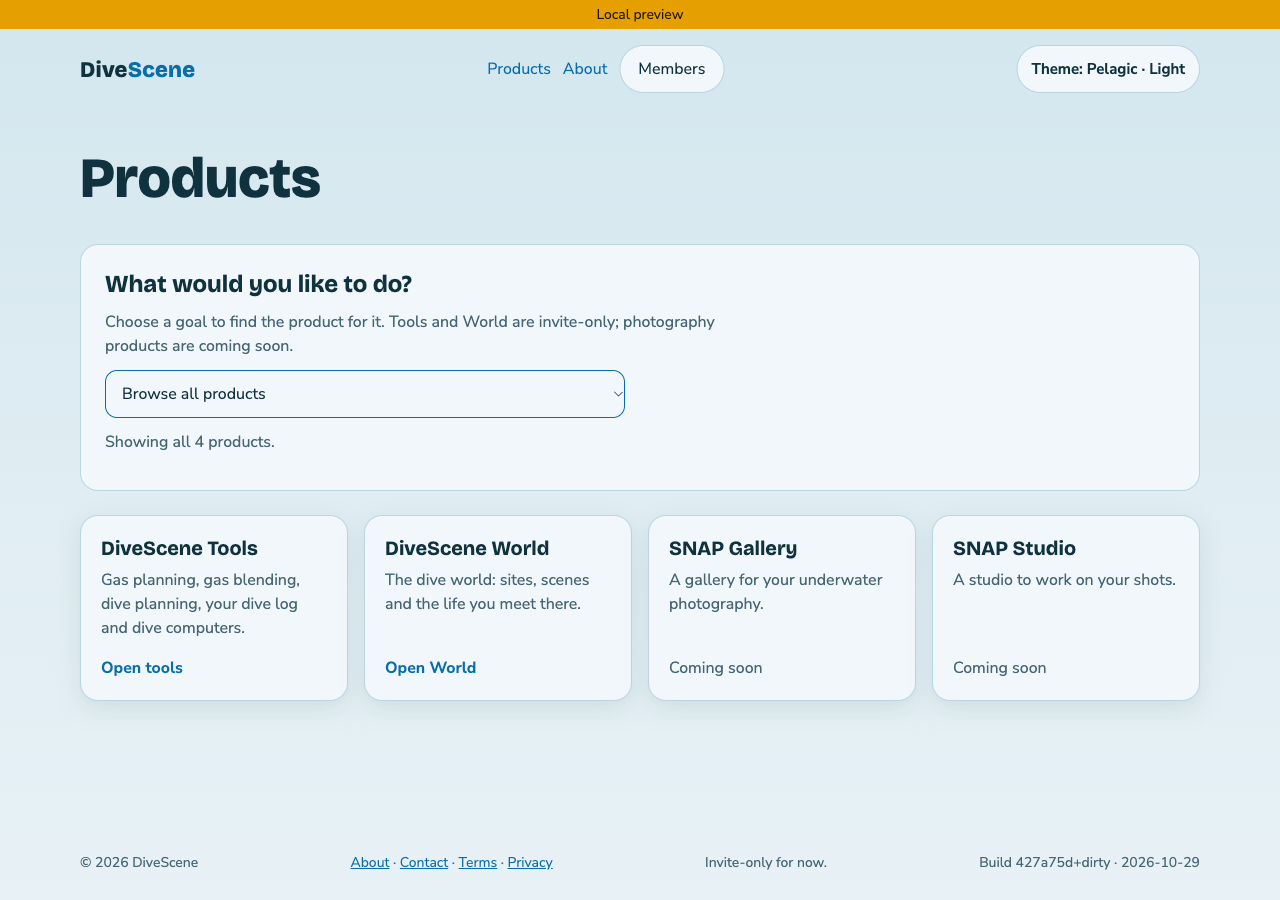
A complete, small user path
Choose a goal→See the product→Open or share
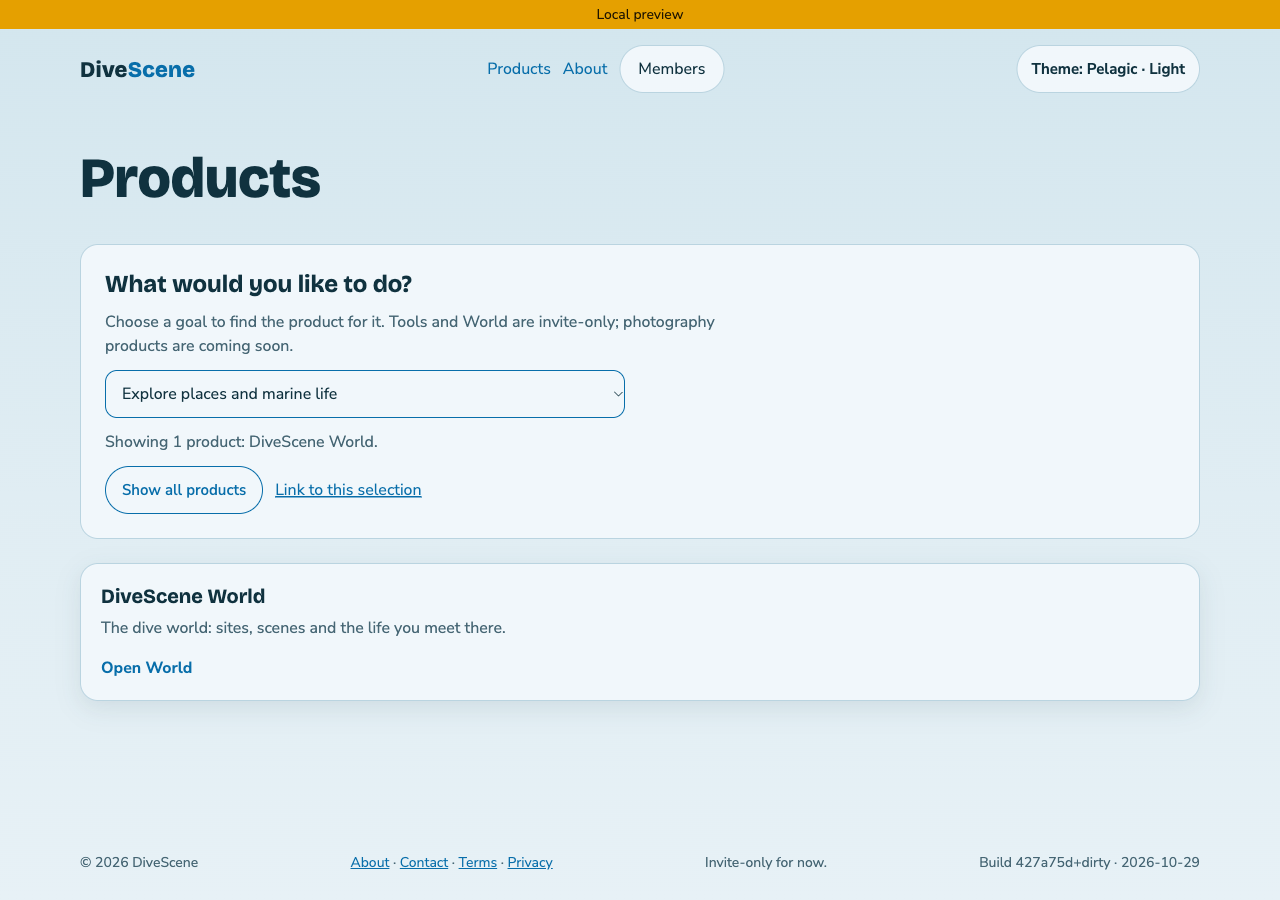
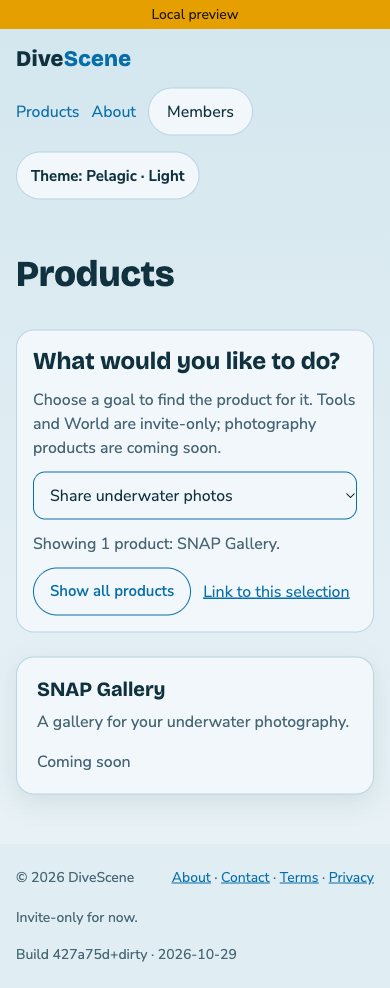
Select “Explore places and marine life” to see DiveScene World and its existing link. Select “Share underwater photos” to see SNAP Gallery with “Coming soon,” without a launch link.
The selection lives in ?goal=…. A shared link, reload, Back and Forward restore the right view. Invalid values show the complete catalogue. With JavaScript off, the original four cards remain usable.
Local preview only. The checks followed product links into explicitly intercepted destination fixtures; they did not access live product services or verify membership access. No personal inputs, storage, new dependencies or cloud services were added.
View the selected World screenshot · Core browser checks · Whole-interface checks
Where the idea came from
The owner asked for “a slightly larger and novel idea.” The specific lead came from inspecting the Products source: four cards describe what each product does, but there was no goal-based route or shareable selection. Easier discovery is a hypothesis, not a reported customer problem.
| Candidate | Decision |
|---|---|
| Goal-based product finder | Selected: one bounded, testable path using content and destinations already in the site. |
| Saved roadmap shortlist | Deferred: active roadmap worktree ownership and broader persistence scope. |
| Photography preparation checklist | Rejected for this run: would require new domain content and assumptions. |
Origin and acceptance were recorded before product edits. Read the original selection record · Read the immutable run intent.
What was verified
| Acceptance | Evidence |
|---|---|
| Correct goal and availability | All four goals yield exactly one correct card; existing destinations remain unchanged; coming-soon cards have no launch links. |
| Sharing and navigation | Selection links, reload, reset, Back/Forward and unrelated URL-state preservation pass. |
| Negative paths and fallback | Unknown values, prototype names and encoded markup show all products; disabled JavaScript retains the original catalogue. |
| Keyboard and phone | Native keyboard type-ahead and Enter work; Tab reaches reset, Space resets and focus returns to the menu; result text uses a live region; no horizontal overflow at 390 px and 320 px; 48 px menu height. Desktop and phone journeys reach intercepted destination fixtures; no live service access. |
| Required repository check | npm run check passes: 403 repository, 23 SSO and 46 infrastructure tests. Four focused finder tests are included in the repository count. |
| Independent review | Pending at this snapshot. Automatic repository review must be inspected against the actual PR head; no review pass is inferred from the tests. |
Six scores, with their limits
0–3 anchors from the shared rubric. Assessor: the fresh coordinator/builder; these are self-assessments at the publication snapshot. No composite ranking or comparison with different tasks.
Usefulness
2/3Verified useful change or decision-quality learning
A working goal-to-product path and shareable selection are verified. Real visitor benefit and demand remain unmeasured.
Correctness evidence
2/3Relevant positive and negative acceptance checks pass
Four focused tests and 77 positive/negative browser assertions pass; full required repository check passes.
Efficiency
1/3Completed with documented avoidable work
Completed build and acceptance within the cap, with avoidable browser-harness and fresh-worktree setup attempts.
Observability
2/3Phase audit, actual quotas and scoped token/check measurements with gaps labelled
Original admission, pre-edit origin, phase audit, actual shared quota and scoped token counters retained; parent/reviewer totals unknown.
Independent verification
1/3Self-check only or incomplete required review
Builder checks passed; required automatic review has not yet started at this publication snapshot. No independent pass claimed.
Learning
2/3Specific lesson applied or bounded improvement queued with evidence
Applied the owner’s whole-interface acceptance guidance to the operating proposal and compact menu; queued a bounded preflight improvement: verify test dependencies and browser-tool file access before costly checks; missing-dependency evidence is retained.
Time, usage and rework
Bounded run
19.36 minutes elapsed at this report snapshot, within a 45-minute total cap.
Run clock: 07:12:02 UTC. Hard deadline: 07:57:02 UTC, including review, reporting and cleanup. Final duration is reported separately after those steps.
Shared weekly quota: 25% at admission → 26% last observed at 07:30:56 UTC. Warn at 70%; stop new phases at 80%. This account-wide change includes other activity.
The next phase requires a fresh quota sample. No five-hour limit or reset was assumed. Review and final handoff usage are not included in this snapshot.
Worker token sample
3,867,196 input tokens, including 3,794,816 cached input.
32,769 output tokens, including 8,058 reasoning output. Runtime sample: 2026-10-29T07:30:56.983Z.
Cumulative counters for this fresh coordinator/builder only, including repeated context. Cached input is a subset of input; reasoning is a subset of output. They are not extra totals. Parent/reviewer tokens and monetary cost are unknown. This is not complete-run or causal efficiency evidence.
One owner-directed usability revision was made. A compact native menu replaced the first stacked-button design after the agent checked the whole phone page. The first mobile design retains that evidence. Setup still caused avoidable work: two browser-runner setup attempts failed; an arrow-key-only native-menu harness also failed before keyboard type-ahead was verified, and two required-check attempts exposed listener permissions and missing existing dependencies. A temporary link reused installed test dependencies and was removed after the passing run. These were setup failures, not invented feature regressions.
Done, deferred and ready to resume
| State | Meaning |
|---|---|
| Done at snapshot | Working finder, four focused tests, 77 browser assertions, required checks, retained screenshots and this report. |
| Remaining closing gates | Publish source-only PR, inspect actual automatic review, validate report layout and manifest, close owned preview/browser and return a clean worktree. Final handoff records actual outcomes. |
| Deferred | Human usability and demand validation, measured discovery benefit, multi-goal selection, copy-link convenience and any release. |
| Release | No merge or deployment in this run. Review completion is separate from source correctness and live benefit. |
| Resume | Use the returned PR/head and closing receipt. Resolve any actual review findings; obtain separate owner release scope before live testing or deployment. |
What this run taught us
Checking the whole phone page caught a weakness that control-only checks missed: the first design pushed the product below the first screen. The compact menu fixes that in the measured viewport. A novel capability can stay within an existing page and still cover a complete user path. Reusing product content limits the risk of invented promises. Next time, verify fresh-worktree test prerequisites and browser-tool file access before launching expensive checks; those setup failures added no product value.
Metrics and gaps · Curated phase audit · Scores and evidence · Consistency manifest. Raw transcripts, private logs and unrelated content are excluded. Hashes establish byte consistency, not truth.